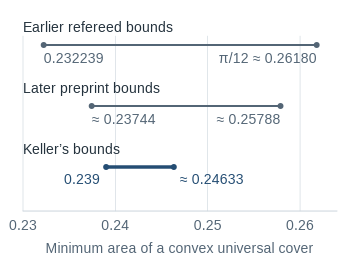
What was already known
The previous refereed interval was 0.232239 to ; the manuscript also compares newer unrefereed bounds of 0.23743658 and 0.257883595…. The new interval narrows both comparisons but does not determine the optimum.
How the result developed
See how the problem developed.
Follow new evidence and revisions to this result.
How the result developed
 AI Proof Watch
Improved bounds for universal convex covers of unit arcs
References
- [1]Improved bounds for universal convex covers of unit arcs
- [2]A lower bound for Moser’s worm problem with rotations and translations
Contribution Assessment
AI involvement
The author says the Claude and OpenAI models carried out the discovery of the geometric reductions, the development and formalization of the proofs in Lean 4
. The author directed the research, reviewed the output and took responsibility for the proofs and code.
- Improved bounds for universal convex covers of unit arcs [1]Acknowledgments · 2609.21968v1
Importance
Substantially narrows a longstanding universal-covering problem and supplies a reported formal proof of the stated bounds.
Technical verification
Keller reports Lean 4.33.1 kernel checking of both area bounds, including the lower-bound interval-certificate argument and a standard-axiom dependency audit. He also explicitly reports reviewing and verifying all model-generated output. These are source-reported checks.
Formal checking
Keller reports Lean 4.33.1 kernel checking of both area bounds, including the lower-bound interval-certificate argument and a standard-axiom dependency audit. He also explicitly reports reviewing and verifying all model-generated output. These are source-reported checks.
- Checker
- Keller’s Lean 4.33.1 development
- Scope
- Both exact convex universal-cover bounds, including the finite lower-bound certificate
- Basis
- Reported by the linked checker
Human understanding
The reviewed source reports Keller’s checking, but does not identify a human explanation of the central reductions covering both bounds. Few is the default for this missing understanding evidence.
Human follow-up work
A lower bound for Moser’s worm problem with rotations and translations [2]
15 Nov 2026Tejasvi Singh Tomar used five unit arcs to improve the lower bound from 0.239 to 0.2414 for covers that allow rotations and translations. Tomar reports reviewing the AI-generated arguments and programs. The new bound applies to this restricted version of the problem.
Tejasvi Singh Tomar
View revision history
Added a figure and caption illustrating the research result.
Added the research timeline.
Added a source excerpt documenting AI involvement.
Restored the archived contribution after a source-based omission review, with exact AI scope, separate human credit and current independent ratings.
Historical geometry/topology full-text backfill after review of the September 16–October 15 priority corpus, statement, baseline, AI role, source version and duplicate status. Initial subscriber alerts disabled. Full audit: data/research/geometry-fulltext-review-2026-10-16.json