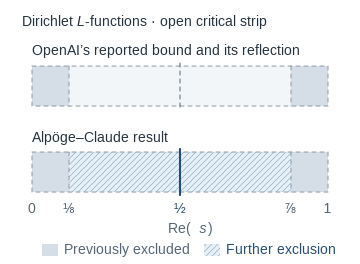
What was already known
Earlier work led by Claude established that more than two thirds of nontrivial zeta zeros are simple and lie on the critical line. OpenAI later reported that Dirichlet L-functions are zero-free to the right of . The full conjecture specifies where every nontrivial zero lies.
How the result developed
- November 2026 · Explanation [1]
Yan Ru Pei, with Claude · Maps the named reductions from local divisibility and slope bounds to the analytic conclusion. The note draws on the theorem statements without independently building the archive.
- 20 Nov 2026 · Result reported [2]
Levent Alpöge reported the AI-assisted result.
- 20 Nov 2026 · Checking report [3]
Andrew Sutherland (MIT), using Claude Code is credited for the reported check.
- 21 Nov 2026 · Checking report [4]
Lean and Mathlib communities, using Lean and independent checkers is credited for the reported check.
- 21 Nov 2026 · Checking report [5]
Michael Rubinstein (Waterloo), using Claude Code is credited for the reported check (The five headline theorems in the November 20 Lean archive, including the classical and Dirichlet claims).
- 21 Nov 2026 · Explanation [6]
Robin Zhang, with GPT-6 Pro · A preliminary note on Alpöge’s proposed proof of the generalized Riemann hypothesis
- 21 Nov 2026 · Explanation [7]
Siniša Slijepčević, with Aleph · Outlines the character-sum bounds and their connections to Hermitian lattices and theta lifts. The author identifies portions whose proofs still need explanation.
- 24 Nov 2026 · Explanation [8]
Jimmie Adriazola, with Claude, GPT and Kimi · Adriazola reconstructs the Lean argument in conventional mathematical language and lists the internal statements still lacking conventional proofs in Section 18.7.
See how the problem developed.
Follow new evidence and revisions to this result.
How the result developed
 AI Proof Watch
Alpöge and Claude’s proposed proof of the Riemann hypothesis
References
- [1]A roadmap of the claimed Lean proof of the Riemann hypothesis and GRH for Dirichlet L-functions
- [2]Levent Alpöge’s announcement
- [3]math.mit.edu: Grh
- [4]leanprover-community.github.io: Riemann hypothesis
- [5]math.uwaterloo.ca: Alpoge claude grh
- [6]A preliminary note on Alpöge’s proposed proof of the generalized Riemann hypothesis
- [7]Outline of Alpöge’s proof of the generalised Riemann hypothesis
- [8]The Alpöge Proof of the Riemann Hypothesis
Contribution Assessment
AI involvement
Alpöge says he guided the collaboration from a simpler setting to the one used in the proof. He describes a choice Claude made in adapting a technique from the function-field setting. Claude’s suggested length of chain of theta lifts, in view of each mimicking multiplicity, was √X.
Here X is the length of the prime-counting sum.
- Levent Alpöge’s announcement [2]Page 1, paragraph beginning “The simple, new, Fourier-analytic ideas” · 2026-11-20
Importance
The proof would settle a Millennium Prize Problem and make many conditional results about primes unconditional, including results about their distribution in arithmetic progressions through the Dirichlet generalization.
Technical verification
The Lean and Mathlib communities reported that the classical theorem matches Mathlib’s Riemann hypothesis. Their joint statement, endorsed by the Lean FRO and the Mathlib Initiative, cites checks of the exported proof by Lean’s kernel, con-leche, con-ron and other independent checkers. Andrew Sutherland and Michael Rubinstein report separate replays of all 175,187 modules and independent-kernel checks. Those reports cover five headline theorems, including the Dirichlet L-function generalization, with only the three standard Lean axioms.
Independent checking
Andrew Sutherland reports building and replaying all 175,187 Lean modules. The five headline theorems use only the three standard Lean axioms. The independent nanoda and con-leche kernels accepted the full export, and con-leche matched all five statements against the challenge. The classical theorem uses Mathlib’s statement of the Riemann hypothesis. The generalization covers zeros in the open critical strip for Dirichlet L-functions.
- Checker
- Andrew Sutherland (MIT), using Claude Code
- Scope
- The five headline theorems in the November 20 Lean archive, including Mathlib’s Riemann hypothesis and the Dirichlet L-function generalization. The report covers a full module replay, an axiom audit and statement comparison against the challenge.
- Basis
- Reported by the linked checker
- Check date
- 2026-11-20
Independent checking
The joint statement reports statement comparison, an axiom audit and checks of the exported proof by multiple proof checkers.
- Checker
- Lean and Mathlib communities, using Lean and independent checkers
- Scope
- The classical Riemann hypothesis as stated by Mathlib in the released Lean library. The community statement addresses that classical claim.
- Basis
- Reported by the linked checker
- Check date
- 2026-11-21
Independent checking
Rubinstein reports a full compile and kernel replay, an axiom audit and successful nanoda checking of the five theorems’ dependencies.
- Checker
- Michael Rubinstein (Waterloo), using Claude Code
- Scope
- The five headline theorems in the November 20 Lean archive, including the classical and Dirichlet claims.
- Basis
- Reported by the linked checker
- Check date
- 2026-11-21
Human understanding
Alpöge identifies the role of repeated theta lifts and the higher-rank automorphic forms he is still studying. Manvir Jaswal rederived the final step from a weighted prime-sum estimate. Michael Rubinstein’s AI-assisted guide treats the zeta-function case. Robin Zhang rewrote a model-generated account to trace the argument’s mathematical sources. Yan Ru Pei and Siniša Slijepčević also produced AI-assisted guides, describing selected reductions and unresolved steps. These accounts explain portions of the Lean argument. Jimmie Adriazola’s reconstruction lists the internal statements still lacking conventional proofs.
Human work and later research
- A preliminary note on Alpöge’s proposed proof of the generalized Riemann hypothesis [6]Robin Zhang, with GPT-6 Pro · 21 November 2026
- A roadmap of the claimed Lean proof of the Riemann hypothesis and GRH for Dirichlet L-functions [1]Yan Ru Pei, with Claude · November 2026
- Outline of Alpöge’s proof of the generalised Riemann hypothesis [7]Siniša Slijepčević, with Aleph · 21 November 2026
- The Alpöge Proof of the Riemann Hypothesis [8]Jimmie Adriazola, with Claude, GPT and Kimi · 24 November 2026
View revision history
Add three scoped proof guides and preserve their human and AI credits.
Added a figure and caption illustrating the research result.
Added the research timeline.
Record the community’s classical verification and Rubinstein’s independent checks and AI-assisted guide. The prior Formal rating and scoped Partial understanding rating still apply.
Independent kernel replay and exact statement comparison support Formal technical verification. Added a scoped account of the analytic end.
Initial curation of the November 20 proof claim and preliminary Lean checking evidence.