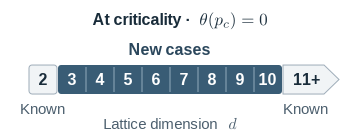
What was already known
Harris–Kesten covered and lace expansion covered ; Kozma and Nitzan conjectured a gluing inequality and proved it would imply the remaining lattice cases. A later OpenAI result extends critical nonpercolation to connected locally finite quasi-transitive graphs with ; it does not erase priority for the earlier lattice claim.
How the result developed
- 28 Aug 2026 · Manuscript date [1]
Justin Leder reported the AI-assisted result in this manuscript.
- October 2026 · Explanation [2]
Arthur Blanc-Renaudie · Reconstructs the gluing mechanism using conditional covariance and a relay induction. The later argument removes a term used in the earlier proof.
- 21 Oct 2026 · Explanation [3]
Jean-Baptiste Gouéré · Gouéré’s explanation of the shared resampling steps
See the problem timelines for Critical percolation on integer lattices and Critical percolation on quasi-transitive graphs.
Follow new evidence and revisions to this result.
How the result developed
 AI Proof Watch
Critical continuity of Bernoulli bond percolation
References
- [1]Critical continuity of Bernoulli bond percolation
- [2]Blanc-Renaudie’s reconstruction of the gluing argument
- [3]Gouéré’s explanation of the shared resampling steps
Contribution Assessment
AI involvement
Justin Leder selected the problem and directed priorities. The disclosure credits Claude with the conditioned-slack argument for critical continuity. Discovery, informal proof and Lean formalization were all produced by the AI system operating autonomously.
- anthropics/formal-math · project disclosureLines 201–204
- Critical continuity of Bernoulli bond percolation [1]Critical continuity of Bernoulli bond percolation
Importance
Fills the long-open lattice dimensions 3–10 and proves a proposed gluing route to a central percolation conjecture.
Technical verification
The project reports a clean Lean build and comparator replay of the lattice theorem against the protected statement. The Lean check uses the three standard axioms.
Formal checking
The project reports a clean Lean build and comparator replay of the lattice theorem against the protected statement. The Lean check uses the three standard axioms.
- Checker
- Justin Leder’s pinned formal-math release; Lean and nanoda kernels
- Scope
- BondPercolation.percolation_continuity for nearest-neighbor bond percolation on ,
- Basis
- Reported by the linked checker
- Anthropic lattice percolation formalization.yamlAnthropic lattice percolation formalization.yaml
- Anthropic’s formal lattice-percolation statement
- Anthropic lattice percolation AUDIT.mdAnthropic lattice percolation AUDIT.md
- Anthropic lattice percolation README.mdAnthropic lattice percolation README.md
Human understanding
Arthur Blanc-Renaudie reconstructs the conditional covariance and gluing mechanism. Jean-Baptiste Gouéré explains the shared cluster-resampling telescope and increasing excess functional while presenting OpenAI’s version of the argument. His cone induction does not trace the retained proof’s global-constant horizontal inequality or relay-peeling induction.
- arXiv manuscript 2610.30063v1Lemma 6, equations (5)–(7): the increasing residual functional, pp. 5–6
- arXiv manuscript 2610.30063v1Lemma 7 and telescoping equation (9), pp. 6–8
- formal math: manuscript sourceOriginal (T), (U), (H) and global-constant explanation
Human work and later research
- Blanc-Renaudie’s reconstruction of the gluing argument [2]Arthur Blanc-Renaudie · October 2026Blanc-Renaudie’s reconstruction of the gluing argument
- Gouéré’s explanation of the shared resampling steps [3]Jean-Baptiste Gouéré · 21 October 2026
Related public discussion
If verified, this is a remarkable breakthrough.
View revision history
Added a figure and caption illustrating the research result.
Added the research timeline.
Added a source excerpt documenting AI involvement.
Linked Gouéré’s human explanation of the shared resampling mechanisms, with the distinct final induction steps kept separate.
Reassessment after tracing the model’s exact contribution to the pinned source.
News-led review of the precise source statement, baseline, AI attribution and importance. Historical inclusion without subscriber alerts; no AIProofWatch full proof audit.