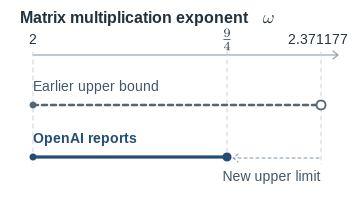
What was already known
Strassen’s recursion reduced the exponent below the textbook value 3. The new claim addresses the asymptotic exponent rather than a fixed-size decomposition.
How the result developed
- 6 Oct 2026 · Research release [1]
OpenAI included the manuscript in its public mathematics release.
- 7 Oct 2026 · Follow-up work [2]
Przemyslaw Uznanski · Rectangular matrix multiplication from polynomial products
- 7 Oct 2026 · Formal checking [3]
Thomas Ahle and Claude Fable 5.1 Ran Lean successfully on an all-fields 9/4 bridge whose second descent uses the formalized algebraically closed case of the original bound.
- 8 Oct 2026 · Formal checking [4]
Palomar registry is credited for the reported check.
- 21 Oct 2026 · Explanation [5]
Alimzhan Amanov, Maxim van den Berg and Jeroen Zuiddam · Multiplying matrices via polynomials: exposition and barriers
- 6 Nov 2026 · Follow-up paper [6]
M. Levent Doğan, Vladimir Lysikov, Keiya Sakabe, Michael Walter · Tensor value and the 9/4 bound for matrix multiplication
See how the problem developed.
Follow new evidence and revisions to this result.
How the result developed
 AI Proof Watch
OpenAI reports: The matrix-multiplication exponent
References
- [1]Sharing AI progress in mathematics
- [2]Rectangular matrix multiplication from polynomial products
- [3]Lean build for the all-fields 9/4 bridge
- [4]Palomar entry PALOMAR-2026-10-08-000005
- [5]Multiplying matrices via polynomials: exposition and barriers
- [6]Tensor value and the 9/4 bound for matrix multiplication
Contribution Assessment
AI involvement
OpenAI is the credited author of the manuscript. This repository contains mathematical manuscripts and supporting proof artifacts produced by an internal OpenAI model.
The release leaves the human input for this result unspecified.
- Release provenance and limitationsREADME opening paragraph
- Original manuscript · family 107AI-use / methodology / credit disclosure; primary construction or proof attribution.
- Sharing AI progress in mathematics [1]
Importance
Substantially advances the general complex matrix-multiplication exponent to at most 9/4; fixed-size counts and hardware speed are separate targets.
Technical verification
The primary source reports the contribution, but the reviewed source passages do not document a completed full rigorous check. Proof availability, authorship and publication status are not treated as completed checking.
Formal checking
The registered all-fields theorem implies the original complex bound as a specialization. This records external formal checking, not an AIProofWatch rebuild or manuscript audit.
- Checker
- Palomar registry (reported)
- Scope
- The complex specialization of the all-fields formal theorem at commit 8375e73ed454e3128500d10d87480c5dd597ff03.
- Basis
- Reported by the linked checker
- Check date
- 2026-10-08
- Navot’s separately attributed field extensionChecking / verification account, theorem hypotheses and artifact scope.
- Navot’s subsequent ring extensionChecking / verification account, theorem hypotheses and artifact scope.
- Palomar checking record for the all-fields theorem [4]Checking / verification account, theorem hypotheses and artifact scope.
- Lean build for the all-fields 9/4 bridge [3]
Human understanding
Amanov, van den Berg and Zuiddam explain the original polynomial-tensor degeneration ingredients and asymptotic-spectrum combination that yield the complex 9/4 bound. Their21October exposition identifies which steps extend to all fields and rectangular shapes; they disclose LLM discussion but state that the exposition and writing choices are theirs. Doğan, Lysikov, Sakabe and Walter explain the polynomial-tensor degenerations and replace the original spectral-point step with an inequality for tensor value. Their proof works over every field.
Human work and later research
- Multiplying matrices via polynomials: exposition and barriers · arXiv record [5]Alimzhan Amanov, Maxim van den Berg, Jeroen Zuiddam · 2026-10-21 · arXiv · Online · arXiv preprintSections1.1–1.4 and3–4: original ingredients, separation, concavity/tripling and square-matrix deduction.
- Tensor value and the 9/4 bound for matrix multiplicationM. Levent Doğan, Vladimir Lysikov, Keiya Sakabe, Michael Walter · 2026-11-06 · arXiv · Online · arXiv preprintSections 1, 5 and 6: shared degeneration and separate tensor-value argument
Human follow-up work
Rectangular matrix multiplication from polynomial products [2]
Submitted 7 Oct 2026; revised 11 Oct 2026Extends OpenAI’s matrix-multiplication analysis to rectangular products, deriving bounds for and consequences for directed all-pairs shortest paths. The paper extends the spectral analysis; it does not provide an independent check of the square-matrix claim.
Przemyslaw Uznanski.
Other useful sources
View revision history
Added a figure and caption illustrating the research result.
Added the research timeline, including a report of Lean checking for the extension to all fields.
Added a source excerpt documenting AI involvement.
Added a separately credited exposition of the tensor degeneration and a variant of the proof over arbitrary fields.
Recorded the dated human exposition of the complex 9/4 mechanism; Human understanding is now Full. No new AI discovery or complete check of the original proof is inferred.
Links the separately attributed Navot generalizations and adds Palomar-reported checking of the formal complex specialization; preserves OpenAI’s original numerical claim and major importance. Historical editorial update; no subscriber alert.
Editorial importance reassessment: rate the scoped impact if correct independently from verification. The claim, limitations, sources, and verification evidence are unchanged.
Historical seed, researched for the initial catalog. Initial alerting disabled.