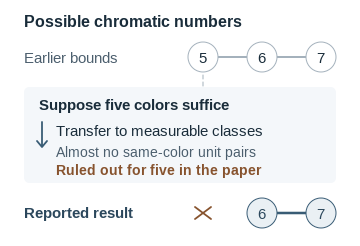
What was already known
The target is excluding every five-coloring, not finding a graph that is difficult for a coloring heuristic.
How the result developed
- 6 Oct 2026 · Research release [1]
OpenAI included the manuscript in its public mathematics release.
- 11 Oct 2026 · Follow-up work [2]
Mikhail Koshelev, Andrey Kupavskii, and Vsevolod Voronov · Ordinary and measurable colorings of Euclidean three-space
- 11 Oct 2026 · Follow-up work [3]
Shisheng Li and Yong Su · Every n points in the plane contain n points with no unit distance
See how the problem developed.
Follow new evidence and revisions to this result.
How the result developed
 AI Proof Watch
OpenAI reports: The chromatic number of the plane
References
- [1]Sharing AI progress in mathematics
- [2]Ordinary and measurable colorings of Euclidean three-space
- [3]Every n points in the plane contain n points with no unit distance
Contribution Assessment
AI involvement
OpenAI is the credited author of the manuscript. This repository contains mathematical manuscripts and supporting proof artifacts produced by an internal OpenAI model.
The release leaves the human input for this result unspecified.
- Release provenance and limitationsREADME opening paragraph
- Original manuscript · family 158AI-use / methodology / credit disclosure; primary construction or proof attribution.
- Sharing AI progress in mathematics [1]
Importance
Excludes every five-coloring and advances the plane-coloring frontier to six or seven, without determining the exact answer.
Technical verification
The primary source reports the contribution, but the reviewed source passages do not document a completed full rigorous check. Proof availability, authorship and publication status are not treated as completed checking.
Human understanding
Few is the default when evidence for a higher level is insufficient. No sufficient account of a named human explaining the scoped central reasoning is established in this assessment. Missing disclosure is not evidence of little understanding.
Human work and later research
- Every n points in the plane contain n points with no unit distance [3]Shisheng Li, Yong Su · 2026-10-11 · arXiv · Online · arXiv preprint
- Ordinary and measurable colorings of Euclidean three-space [2]Mikhail Koshelev, Andrey Kupavskii, Vsevolod Voronov · 2026-10-11 · arXiv · Online · arXiv preprint
View revision history
Added a figure and caption illustrating the research result.
Added the research timeline.
Added a source excerpt documenting AI involvement.
Editorial importance reassessment: rate the scoped impact if correct independently from verification. The claim, limitations, sources, and verification evidence are unchanged.
Historical seed, researched for the initial catalog. Initial alerting disabled.