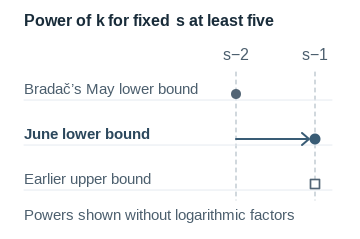
What was already known
Bradač’s first version used his polarity-graph construction to reach the power . Earlier special cases already reached the conjectured power for and .
- Bradač’s first version with the exponent [1]Source context
- OpenAI’s September result for Source context
- OpenAI’s September result for fixed Source context
How the result developed
See how the problem developed.
Follow new evidence and revisions to this result.
How the result developed
 AI Proof Watch
Off-diagonal Ramsey numbers
References
- [1]Off-diagonal Ramsey numbers · first preprint
- [2]Off-diagonal Ramsey numbers · strengthened result
Contribution Assessment
AI involvement
Bradač reports that the argument raising the exponent from to was found by an internal model at OpenAI and communicated to the author.
He supplied the original construction and wrote the manuscript. Claude assisted a separate appendix calculation.
- Off-diagonal Ramsey numbers [2]Introduction, Declaration on the use of
Importance
The revised theorem proves the conjectured power up to a logarithmic loss for each fixed s. It improves the best prior lower bounds for .
Technical verification
The proof appears in §2.5. The acknowledgements report a reading of an earlier draft and do not document checking the final exponent argument.
Human understanding
Bradač explains how the new argument uses his polarity graphs and modifies the construction to obtain the higher power.
View revision history
Added a figure and caption illustrating the research result.
Added the research timeline.
Added a source excerpt documenting AI involvement.
Bradač explicitly credits an internal OpenAI model with the argument raising the power exponent from to , using his original construction. This June advance is distinct from the September sharp log exponents.