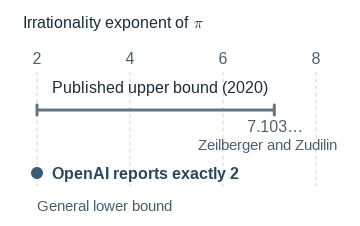
What was already known
The target is an optimal asymptotic approximation exponent, rather than additional decimal digits of .
How the result developed
- 6 Oct 2026 · Research release [1]
OpenAI included the manuscript in its public mathematics release.
- 7 Oct 2026 · Follow-up paper [2]
Jingwen Liu, Kai Jiang, Pingwen Zhang · Irrationality exponents of logarithms of positive rational numbers
- 19 Oct 2026 · Follow-up paper [3]
Gregory V. Chudnovsky · The irrationality exponent of the lemniscate period: A determinant proof with a Lean 4 formalization
- 20 Oct 2026 · Follow-up paper [4]
Gregory V. Chudnovsky · Irrationality exponents of logarithmic numbers: Values, quotients, and graded approximation
- 22 Oct 2026 · Follow-up paper [5]
Gregory V. Chudnovsky, David V. Chudnovsky · Irrationality Exponents of Real CM Elliptic Periods and Powers of the Lemniscate Period
- 6 Nov 2026 · Formalization scope review [6]
Gilheum Park found that Lean replaces the packing argument in Lemma 2.2 with a discrete box and uses a larger constant for the intermediate bound.
See how the problem developed.
Follow new evidence and revisions to this result.
How the result developed
 AI Proof Watch
OpenAI reports: The irrationality exponent of
References
- [1]Sharing AI progress in mathematics
- [2]Irrationality exponents of logarithms of positive rational numbers
- [3]The irrationality exponent of the lemniscate period: A determinant proof with a Lean 4 formalization
- [4]Irrationality exponents of logarithmic numbers: Values, quotients, and graded approximation
- [5]Irrationality Exponents of Real CM Elliptic Periods and Powers of the Lemniscate Period
- [6]Park: comparison of the exponent manuscript and Lean proof
Contribution Assessment
AI involvement
OpenAI is the credited author of the manuscript. This repository contains mathematical manuscripts and supporting proof artifacts produced by an internal OpenAI model.
The release leaves the human input for this result unspecified.
- Release provenance and limitationsREADME opening paragraph
- Original manuscript · family 017AI-use / methodology / credit disclosure; primary construction or proof attribution.
- Sharing AI progress in mathematics [1]
Importance
Determines the optimal irrationality exponent of , resolving the stated approximation question.
Technical verification
The primary source reports the contribution, but the reviewed source passages do not document a completed full rigorous check. Proof availability, authorship and publication status are not treated as completed checking.
Possible mismatch: Gilheum Park reports that Lean uses a discrete box and a larger constant in the packing argument corresponding to Lemma 2.2 of the manuscript. The selected Lean theorem states the same irrationality exponent of 2.
Human understanding
Few is the default when evidence for a higher level is insufficient. No sufficient account of a named human explaining the scoped central reasoning is established in this assessment. Missing disclosure is not evidence of little understanding.
Human work and later research
- Irrationality exponents of logarithms of positive rational numbers [2]Jingwen Liu, Kai Jiang, Pingwen Zhang · 2026-10-07 · arXiv · Online · arXiv preprint
- The irrationality exponent of the lemniscate period: A determinant proof with a Lean 4 formalization [3]Gregory V. Chudnovsky · 2026-10-19 · arXiv · Online · arXiv preprint
- Irrationality exponents of logarithmic numbers: Values, quotients, and graded approximation [4]Gregory V. Chudnovsky · 2026-10-20 · arXiv · Online · arXiv preprint
- Irrationality Exponents of Real CM Elliptic Periods and Powers of the Lemniscate Period [5]Gregory V. Chudnovsky, David V. Chudnovsky · 2026-10-22 · arXiv · Online · arXiv preprint
View revision history
Added a figure and caption illustrating the research result.
Added the research timeline.
Added a source excerpt documenting AI involvement.
Recorded the reported difference in an intermediate packing estimate.
Editorial importance reassessment: rate the scoped impact if correct independently from verification. The claim, limitations, sources, and verification evidence are unchanged.
Historical seed, researched for the initial catalog. Initial alerting disabled.